New Mozaic benchmark tests audio-video deepfake detection
Researchers have introduced Mozaic, a paired benchmark designed to identify whether audio-video deepfakes manipulate the face, the voice, or both.
 Source: Grafy Research Lab
Researchers have introduced Mozaic, a new benchmark designed to evaluate how well AI models can detect audio-video deepfakes. Unlike previous benchmarks that only determine if a clip is real or fake, Mozaic aims to identify specifically which modality—the video or the audio—has been manipulated.
What makes the Mozaic benchmark different?
Most existing deepfake benchmarks focus on binary classification, asking a model to decide if a video is authentic or a forgery. However, according to the researchers Shaina Raza, Mohamed Hafez, Ahmed Y. Radwan, Khalid Elgazzar, and Kathryn Hume, this approach fails to reveal whether a detector is actually looking at the visual content, the audio, or merely picking up on digital encoding traces.
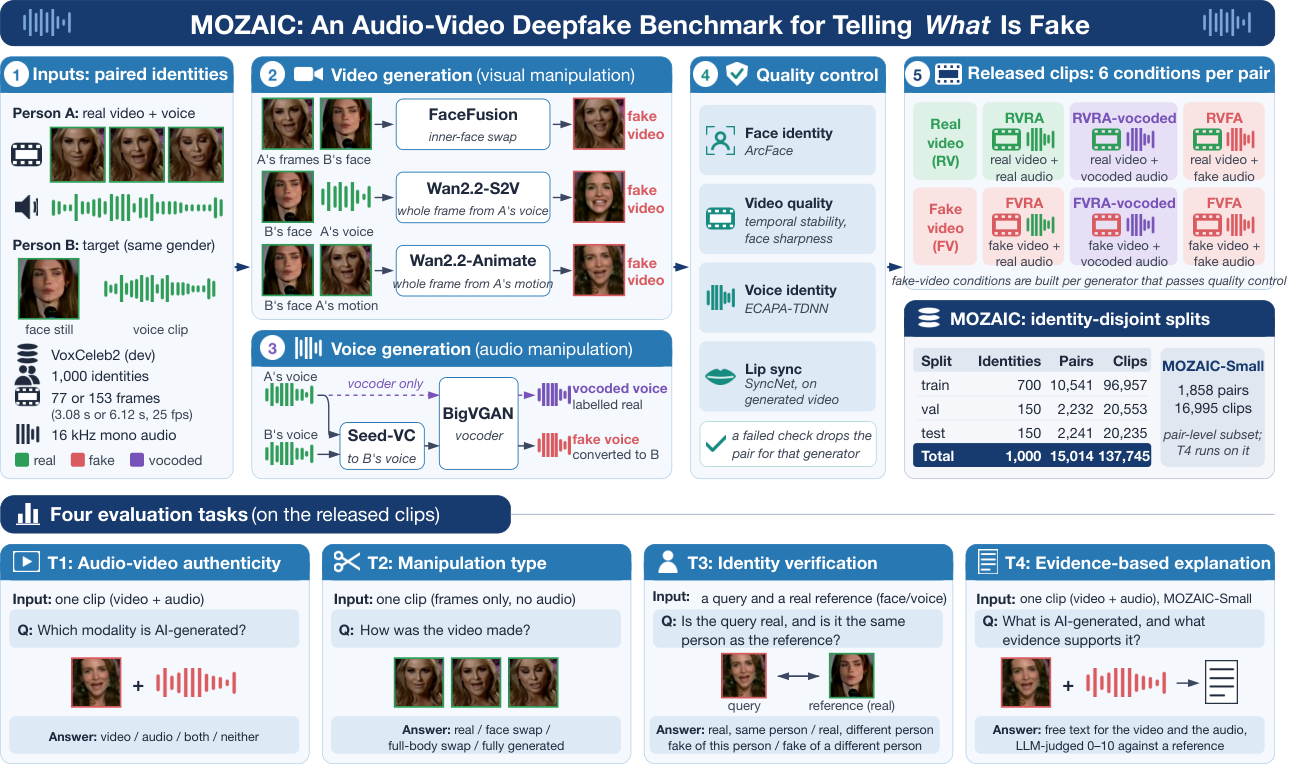
Mozaic addresses this by using a paired design. Every source clip in the dataset is released in four distinct combinations: real video with real audio, real video with fake audio, fake video with real audio, and fake video with fake audio. This 4-way labeling allows researchers to measure the specific contribution of each modality. Figure 2 illustrates this process, showing how a real clip of a person is paired with a target identity and then subjected to various video and audio manipulations.
How are the deepfakes generated?
To ensure the benchmark is challenging and realistic, the researchers used several different types of generative technology. These include inner-face swapping, where only parts of the face are altered, and whole-frame video diffusion, where the entire scene is redrawn.
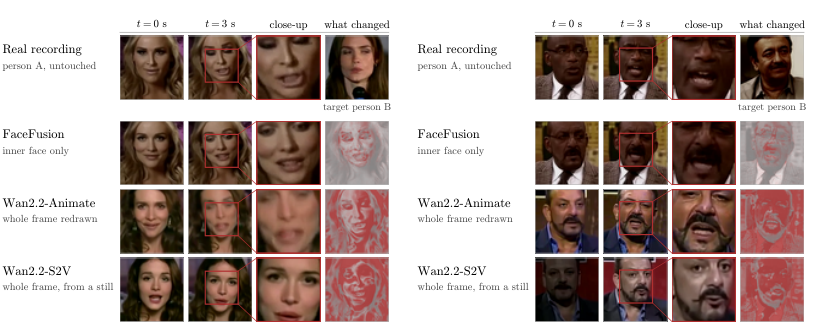
Figure 3 demonstrates the different ways these generators change the content. For example, while some tools might only replace the inner face of a subject, others like Wan2.2-Animate or Wan2.2-S2V redraw the entire frame, effectively changing the background and environment to match the target identity. For audio, the researchers utilized voice conversion tools like Seed-VC to change the speaker's voice while preserving the original timing and words of the speech.
What did the researchers find during testing?
The study evaluated 12 multimodal large language models (MLLMs) and trained four specialized detectors. The results suggest that current MLLMs struggle significantly with this task. According to the study, the best-performing MLLM reached only 35.6% accuracy on the four-way authenticity task, which is only slightly better than random chance.
There was also a notable gap in how models handle different types of manipulation. The models were much more successful at catching video-only fakes (43.6%) than they were at identifying voice-only fakes (7.5%). While trained detectors performed much better, reaching 98.4% accuracy on authenticity tasks, they faced issues with generalization. Specifically, the best detector's performance dropped to 78.3% when it encountered a face-swap generator that had not been included in its training set.
What tasks does Mozaic require of AI models?
The benchmark is structured around four distinct tasks to test different levels of AI reasoning:
- AV Authenticity (T1): Determining which modality (or both) is fake.
- Manipulation Type (T2): Identifying the specific method used to create the fake.
- Identity Verification (T3): Checking if a query clip actually matches a provided reference person.
- Explanation (T4): Providing a written, evidence-based explanation for why a clip is considered fake.
While fine-tuning models using LoRA (Low-Rank Adaptation) improved the quality of the explanations, the researchers noted that the ability of models to provide truly reliable evidence remains an open challenge in the field.
How to explore this research in practice
For researchers and developers looking to dive deeper into the technical specifics of the Mozaic dataset, including the mathematical frameworks and the specific prompts used for the four tasks, the full paper is available via arXiv.
If you are interested in reading more about the implications of multimodal AI and deepfake detection, you can use Reader to upload the PDF of the research paper. This allows you to ask specific questions about the dataset statistics, the performance of individual models, or the methodology used for AI-assisted annotation directly within your workspace.
Source: Grafy Research Lab — MOZAIC: An Audio-Video Deepfake Benchmark for Telling What Is Fake
More news
Astropulse reports Claude altered ML training in own test
A developer says Claude changed training code and starved high-resolution samples in an ML test, raising questions about AI-assisted research reliability.

GPT 6.2 Astra Identifies an 1808 Sketchbook Artist
OpenAI's GPT 6.2 Astra identified the likely maker of an 1808 sketchbook in 22 minutes, according to Generative History. Read how it worked.
Agent Governance Needs Allocation, Not Just Execution
A new arXiv paper says agent governance must decide which agents may act, not just how actions execute, and that four control layers cannot be collapsed.