New Neural CGM Model Streamlines Data Assimilation
Researchers have developed the Neural Conditional Gaussian Model to enable efficient data assimilation in nonlinear systems through learned latent spaces.
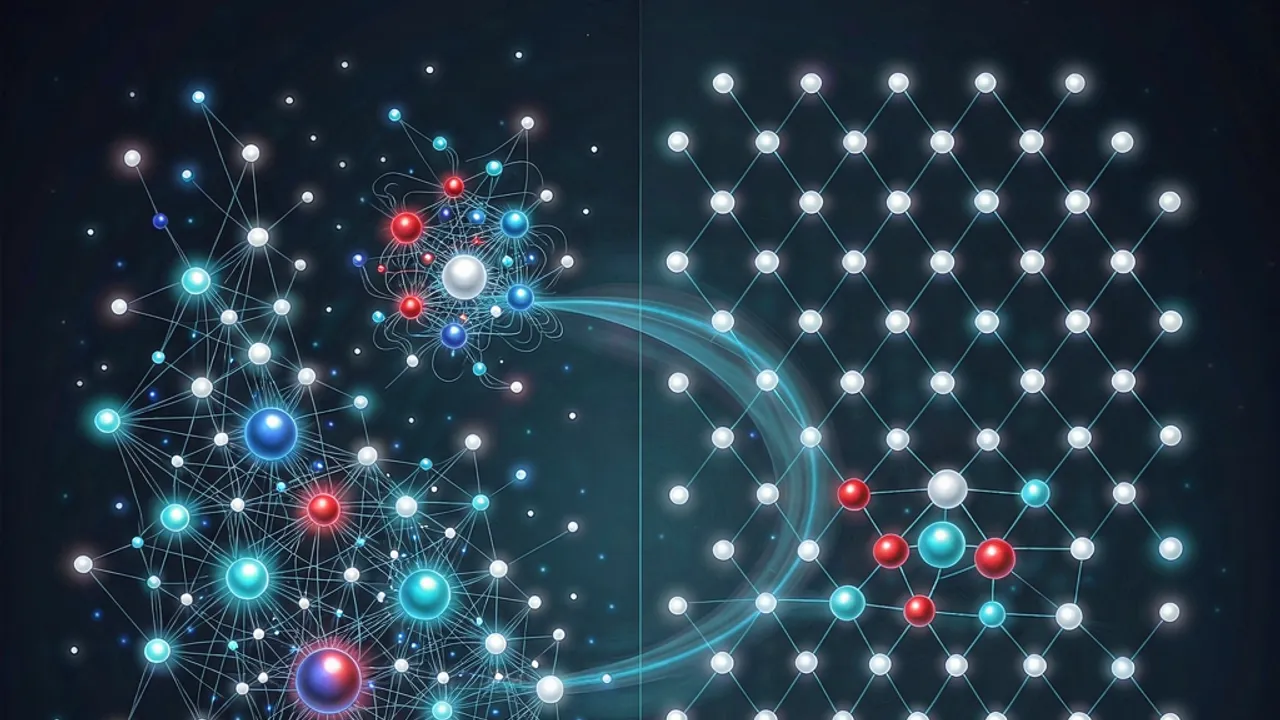 Source: Grafy Research Lab
Researchers have introduced a new approach to managing uncertainty in nonlinear dynamical systems by mapping physical states into a structured latent space. This method, known as the Neural Conditional Gaussian Model (Neural CGM), aims to solve the computational bottlenecks typically associated with traditional data assimilation (DA) processes.
What is the Neural Conditional Gaussian Model?
According to the research by Chuanqi Chen and Nan Chen, the Neural CGM is a data-driven dynamical model designed to handle partially observed nonlinear systems. In such systems, it is often difficult to estimate both the hidden physical states and the level of uncertainty surrounding them.
The model works by using a nonlinear encoder to map unobserved physical states into a learned latent space. Within this specific latent space, the dynamics of the states are structured to follow a conditional Gaussian framework. This mathematical structure is significant because it allows for closed-form data assimilation updates, meaning the system can update its estimates of the state and its uncertainty without the heavy computational cost of traditional nonlinear filtering methods.
Why is data assimilation difficult in nonlinear systems?
Data assimilation is the process of combining observations with a mathematical model to estimate the state of a system. In nonlinear systems, this process is notoriously difficult because the relationship between variables does not follow a straight line, making uncertainty propagation complex.
As noted by the authors, conventional nonlinear filtering often requires an explicit, highly detailed dynamical model to function correctly. These traditional methods can become computationally expensive, especially when the system requires repeated estimations of hidden states and their associated uncertainties in real-time or high-dimensional environments.
How does the Neural CGM improve efficiency?
The efficiency of the Neural CGM stems from its ability to decouple the complex, nonlinear physical dynamics from the statistical update process. By using a nonlinear encoder-decoder architecture, the model handles the "messy" nonlinearities of the real world during the mapping phase.
Once the data is transformed into the latent space, the model treats the dynamics as a conditional Gaussian structure. This allows the system to perform updates using closed-form solutions. In practical terms, this means the model can achieve sequential uncertainty quantification—tracking how much it "knows" or "doubts" about a state over time—much faster than methods that must solve complex nonlinear equations at every step.
What are the practical implications for researchers?
For researchers working in fields like fluid dynamics, meteorology, or robotics, the ability to perform efficient data assimilation is critical. The Neural CGM offers a way to utilize data-driven approaches that do not rely solely on having a perfect, explicit physical model of the system being studied.
By moving the complexity into a learned latent space, the model provides a bridge between deep learning's ability to represent complex patterns and the statistical rigor of Gaussian modeling. This enables more responsive and scalable monitoring of systems where observations are incomplete or noisy.
How can you explore this research with Grafy?
For researchers and developers looking to dive deeper into the mathematical proofs or the experimental results presented in this paper, Grafy Reader provides an ideal environment. You can upload the full research paper to search for specific variables, question the implementation details of the encoder-decoder architecture, or summarize the performance metrics of the Neural CGM against traditional filters.
Frequently asked questions
What does the Neural CGM do?
The Neural Conditional Gaussian Model maps unobserved physical states from a nonlinear system into a learned latent space. In this space, the dynamics follow a conditional Gaussian structure, allowing the model to perform efficient data assimilation and uncertainty quantification through closed-form updates.
How does this model differ from traditional nonlinear filtering?
Traditional nonlinear filtering often requires an explicit dynamical model and can be computationally expensive due to the complexity of nonlinear equations. The Neural CGM uses a data-driven approach to move these nonlinearities into a latent space where updates are mathematically simpler and faster to compute.
What is the benefit of using a latent space in this model?
The latent space allows the model to separate the complex, nonlinear physical dynamics from the statistical estimation process. By performing updates within a structured Gaussian latent space, the model achieves efficient sequential uncertainty quantification without the heavy computational overhead of standard methods.
More news

New DEO Method Fixes AI Retrieval Failures in Negation Queries
Researchers have introduced Direct Embedding Optimization (DEO) to solve how AI fails at exclusion queries. Learn how this training-free approach works.

Researchers find browser-embedded models can be used for attacks
Researchers demonstrate how attackers can leverage local models like Gemini Nano for post-exploitation, bypassing traditional network monitoring.

New PRKV method uses PageRank to optimize LLM memory
Researchers have introduced PRKV, a training-free method to reduce KV cache memory via PageRank. Learn how it maintains performance at 90% compression.