New Study Links In‑Context Learning to Out‑of‑Context Hallucinations in LLMs
Researchers reveal a unified mechanism behind in‑context learning and out‑of‑context hallucinations.
 Source: Grafy Research Lab
Large language models (LLMs) can follow task‑specific rules when prompted, a capability known as in‑context learning (ICL), yet they sometimes generate statements that stray from the supplied evidence, a phenomenon called out‑of‑context (OOC) hallucination. A new arXiv paper titled A Mechanistic Analysis of In‑Context Learning and Out‑of‑Context Hallucination argues that these two behaviors share a common mechanistic foundation.
What does the paper examine?
The authors set out to bridge two research strands that have traditionally been studied in isolation. One line investigates how LLMs infer and apply explicit rules from a handful of examples presented in the prompt – the essence of ICL. The other line focuses on why models occasionally produce information that is not grounded in the given context, leading to OOC hallucinations. According to the authors, separating these topics obscures the underlying dynamics that govern both successes and failures in contextual reasoning.
How do the researchers unify the mechanisms?
The paper proposes a "functional‑role" framework that treats the prompt as a dynamic context populated by multiple internal roles. Role information – such as "instruction", "example", or "evidence" – can be represented inside the model without requiring external supervision. The key observation, highlighted by the authors, is that the same internal representations that enable the model to follow instructions in ICL can also be mis‑aligned, causing the model to ignore or overwrite evidence and thus hallucinate. By viewing the prompt as a collection of interchangeable roles, the authors suggest that ICL and OOC hallucination are two sides of a single mechanistic coin.
Why does this matter for developers and researchers?
Understanding that ICL and hallucination stem from a shared internal process offers a clearer target for mitigation strategies. If role representations can be monitored or steered, developers could design prompts that reinforce the "evidence" role while suppressing the "generation" role that leads to unfounded claims. The paper hints at the possibility of diagnostics that surface role‑conflict signals, enabling early detection of potential hallucinations before a response is rendered. For researchers, the unified view opens new avenues for probing model internals, such as tracing how role embeddings evolve during generation.
How can Grafy users explore these insights?
Grafy provides tools that let creators and researchers experiment with prompt design and model behavior without leaving the platform.
-
Grafy Chat (/chat) lets you run multiple LLMs side‑by‑side, compare how each handles the same in‑context examples, and observe where hallucinations appear. By toggling the prompt structure – for instance, separating instruction blocks from evidence blocks – you can directly test the functional‑role hypothesis.
-
Grafy Reader (/reader) makes it easy to load the full paper PDF, ask the AI to summarize sections, and even query the model about the authors' proposed framework. This interactive reading experience can surface the exact role representations the paper describes, helping you verify the claims on your own data.
While Grafy does not yet offer a built‑in “role‑visualizer”, the combination of Chat and Reader lets you prototype prompt patterns, capture model outputs, and feed them into the Graph view (/graph) to track how changes in context affect downstream generations. This workflow aligns with the paper’s call for systematic probing of dynamic context.
What are the next steps for the community?
The authors acknowledge that their analysis is an early step toward a full mechanistic theory. Future work could involve:
- Designing training objectives that explicitly encode role distinctions, reducing the likelihood of OOC hallucination.
- Building diagnostic tools that flag when a model’s internal role embeddings diverge from the intended prompt structure.
- Extending the framework to multimodal models, where visual and textual roles interact.
Grafy’s modular ecosystem – from Code for custom probing scripts to Operator for automated web tasks – provides a fertile ground for implementing and testing these ideas.
Source: https://arxiv.org/abs/2611.24000
Frequently asked questions
How does the functional‑role view differ from previous explanations of hallucination?
Previous work often treats hallucination as a failure of grounding or a by‑product of probability sampling. The functional‑role view, however, frames it as a mismatch between internally represented prompt roles, meaning the model may correctly follow a learned generation pattern while ignoring the evidence role.
Can I use Grafy Chat to reduce hallucinations in my own applications?
Yes. By experimenting with prompt layouts that clearly separate instruction, example, and evidence sections, you can observe how different models respond. Grafy Chat’s side‑by‑side comparison helps identify which model respects the evidence role best.
Does the paper provide concrete metrics for measuring role alignment?
The authors discuss the concept of role‑conflict signals but do not release a standardized metric in the preprint. They suggest that future work should develop quantitative probes to assess how well a model maintains each functional role during generation.
Source: Grafy Research Lab — A Mechanistic Analysis of In-Context Learning and Out-of-Context Hallucination
More news

RSI‑Prime Dataset Enables LLMs to Train Other Models
A new arXiv dataset, RSI‑Prime, provides 350 full training trajectories to teach large language models how to conduct model‑training.

Resolution as Attention proposed to boost agent memory efficiency
Researchers introduce Resolution as Attention (RAA), a method that allocates perceptual detail to past interactions.
OmniDebias introduces bias‑centric fairness for omni‑modal LLMs
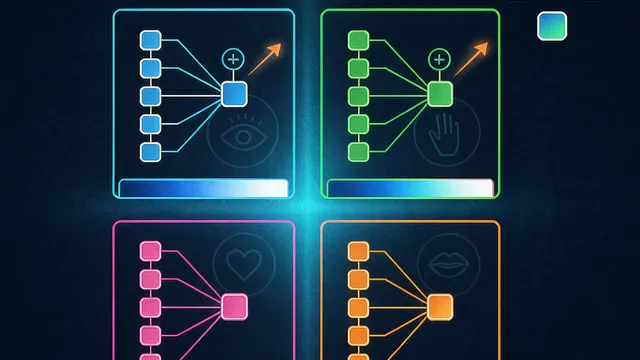
Researchers unveil OmniDebias, a bias‑centric method that unifies fairness across attributes and modalities in omni‑modal large language models.