Ontology-Grounded Data Agent Aims to Make AI Data Analysis More Reliable
A new AI data agent uses an ontology to guide exploration and constrain actions, aiming to reduce errors in large, messy data lakes. It reports results.
 Source: Grafy Research Lab
What Is the Ontology-Grounded Data Agent?
The source introduces OGDA as an ontology-grounded data agent for reliable analysis over heterogeneous data lakes. The authors describe a full-pipeline data analysis task in which an LLM agent must locate and integrate information across many tables with different schemas. OGDA uses a compact ontology to reduce exploration overhead and constrain data processing. According to the source, the ontology is not simply added as context. It is used to ground the agent's context and actions.
The paper frames the problem as one of orchestration. A data lake may contain relational tables that do not share a common schema, so an agent cannot assume that similar records are easy to find or combine. OGDA proposes an ontology that records how fields connect through shared concepts. The source says this can help an analyst or agent locate and combine the data a question requires without inspecting every raw file.
The source describes a construction route that relies on agentic hypothesis testing. A proposing agent turns raw sources into candidate schemas, concepts, and relations, and an independent verifier assesses each candidate against the data. The work is from the Grafy Research Lab and lists authors affiliated with institutions including the Hong Kong University of Science and Technology and Hong Kong Baptist University. The source is an arXiv paper dated in November 2026. For the news desk, the central claim is not that LLMs cannot analyze data at all, but that reliable end-to-end analysis may require explicit representation of the data semantic structure.
Why Do Data Agents Struggle With Large Lakes?
Existing data agents follow task-specific exploration. In massive lakes, that exploration can exhaust the context window before the task finishes. As context fills, the source says, the agent's reasoning degrades, leading it to locate and process incorrect data files. Errors then propagate into the final answer.
The source also notes that context management methods can improve context efficiency by managing external memory, summarizing completed subgoals, or compressing interaction histories. However, those methods do not explicitly model the semantic meaning of the underlying data or relationships between sources. The paper points to semantic layers as a common practice among data analysts. OGDA builds on that idea by making the ontology part of agent execution.
This helps explain why the problem is difficult. A lake can be large, heterogeneous, and poorly documented. An agent may need to compare tables from different sources, infer what fields mean, and decide which files matter. Without a structured way to represent those relationships, exploration can become broad, costly, and fragile.
The source says existing data agents assume that the data relevant to a task can be found and understood by exploring sources within the agent context. That assumption does not hold in real-world data lakes, the paper argues.
How Does OGDA Ground an Agent?
The method has two broad parts. First, agentic ontology construction. A proposer agent induces schemas, concepts, and relations from raw sources; a verifier checks proposals against the underlying data; experience distillation captures lessons. Second, ontology-grounded action. The agent must commit relevant ontology elements to a task graph, and actions on data outside that graph are rejected.
Figure 1 shows direct exploration can select incorrect files and propagate source-selection errors into the result, while OGDA grounds relevant ontology elements in an explicit task graph that guides exploration of corresponding sources. Figure 2 shows the overall workflow, including ontology construction and task-graph-based action.
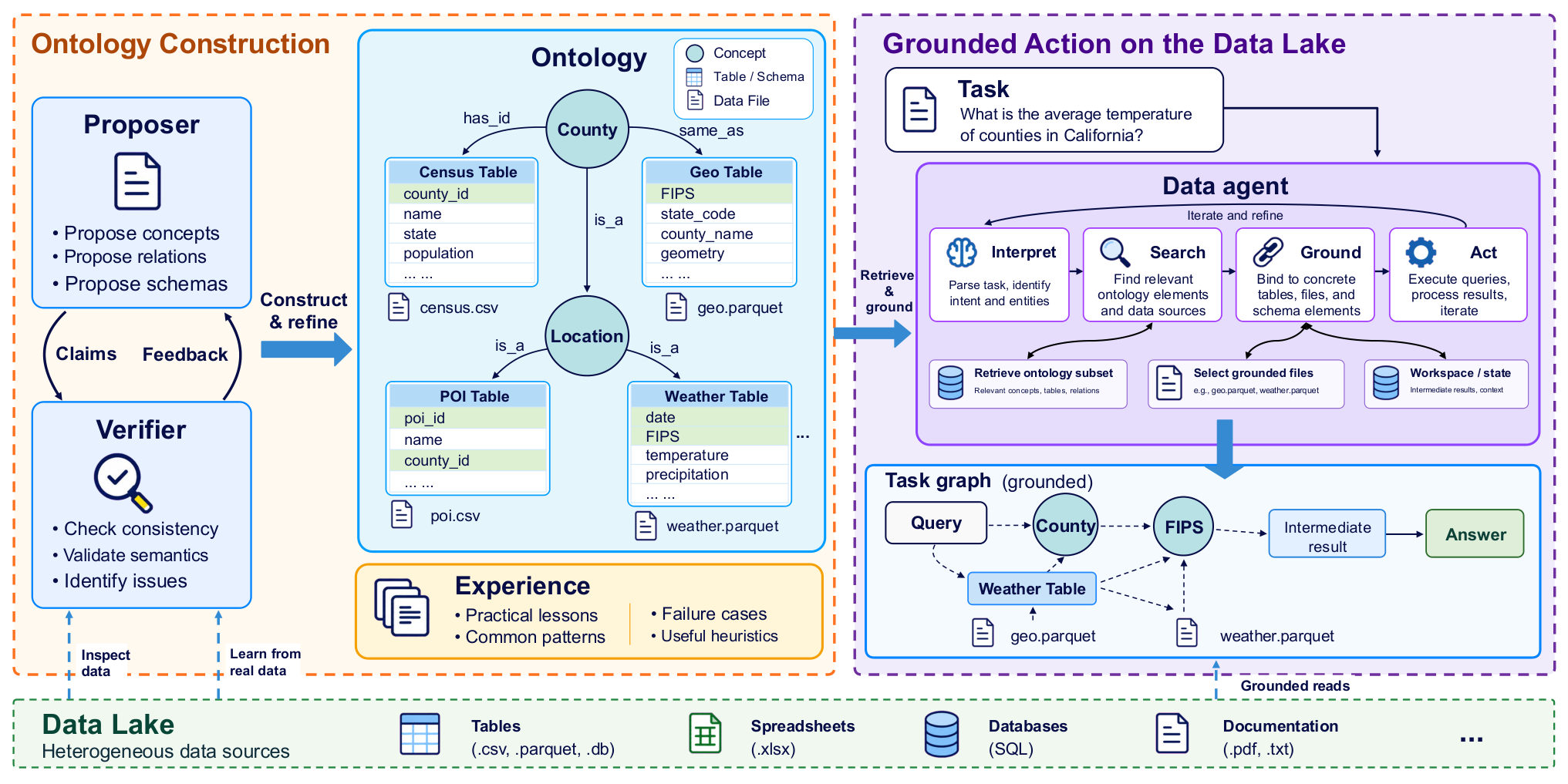
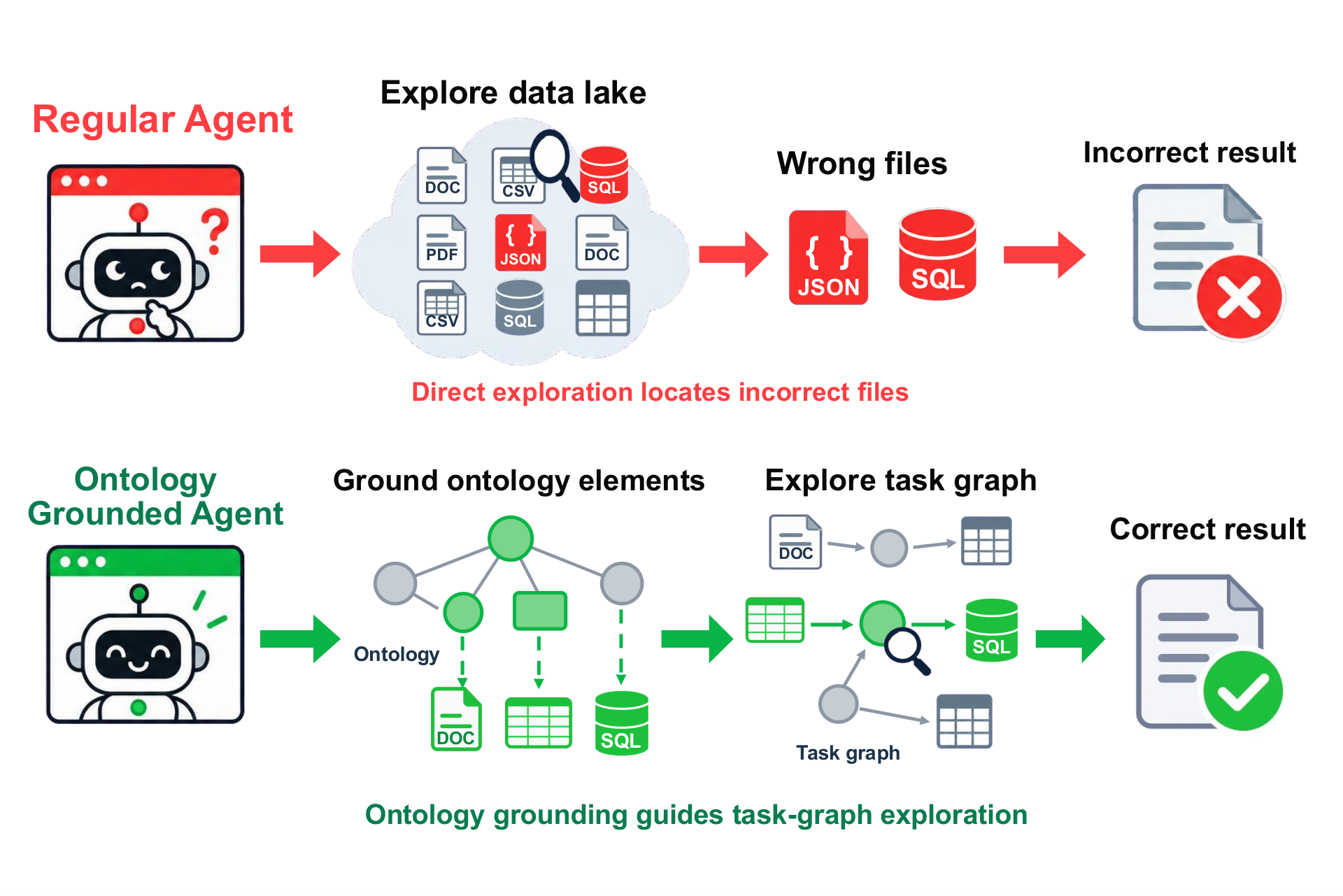
The source describes this arrangement as making the ontology responsible for what the agent sees and for which data it may use, so context length follows task scope instead of lake size.
The task graph is central in the source description. It connects grounded files, intermediate results, and the final answer. The agent can extend the graph only after observing the semantic meaning of the data. This is one way the method tries to keep execution aligned with the ontology rather than allowing unconstrained exploration.
What Did the Experiments Show?
The experiments were run on KramaBench and DiscoveryBench with three LLM backbones. According to the source, OGDA outperformed the strongest baselines by up to 10.82 points. The paper also examines whether an ontology can be reused across backbones and which components improve answer quality.
The source describes research questions about whether the ontology guides exploration to task-support files, whether an ontology can be reused across backbones, and which components improve answer quality. The ablation study examines the ontology-grounded agent, verifier, semantic layer, and experience.
Figure 7 identifies primary error types from OGDA execution trajectories on KramaBench and DiscoveryBench, with percentages computed over questions receiving less than full credit. The dashed line separates errors in substance from cases with right or nearly right substance.
The results are significant for AI agents that operate over private or organizational data. If an agent cannot reliably know which sources to use, it may produce confident but incorrect analysis. The source presents OGDA as a step toward changing that outcome. The source says the results suggest that explicitly modeling the data lake is a key step toward reliable end-to-end data agents.
How Could This Relate to Grafy?
For researchers who want to read and interrogate this paper, Grafy's Reader lets users read, search, and question PDFs and papers with AI. The connection here is methodological rather than a claim that Grafy has shipped OGDA. A developer working on data agents might use Grafy Chat to sketch hypotheses and Reader to dig through source material, but OGDA itself remains a research project described in the source.
Grafy News Desk perspective: teams building AI analysis tools today may need more than retrieval. They may need ways to represent knowledge about messy data sources and to constrain agent behavior. The OGDA paper is a useful checkpoint for designing such systems, even if the specific implementation is not part of Grafy.
Frequently asked questions
Does OGDA use a predefined ontology?
No, according to the source, OGDA builds its ontology through agentic hypothesis testing. A proposer agent induces schemas, concepts, and relations, while a verifier checks proposals against the data. The source says this construction process helps with data lakes that may not have a ready-made ontology.
How much did OGDA improve over its baselines?
Across KramaBench and DiscoveryBench with three LLM backbones, OGDA outperformed the strongest baselines by up to 10.82 points, the source reports. The paper describes main results, ablations, and analyses. The source does not say the improvement was the same across every task or model.
Can an ontology be reused across different agent backbones?
The source includes an experiment on cross-backbone reuse and lists a research question about whether an ontology can be reused across backbones. It also mentions an EvoOntology configuration. The source does not present a simple universal answer for all reuse cases.
More news

Frontier3DBench Tests Whether Coding Agents Build 3D Worlds
Einsia's Frontier3DBench tests whether coding agents can build 3D objects, scenes and working worlds; GPT-6.1-sol led overall. See what it means.

Anthropic launches Claude Fable 5.2, Mythos 5.2, cuts API prices 20%
Anthropic's Claude Fable 5.2 and Mythos 5.2 top several third-party benchmarks and cut API prices 20%. Here's what the effort settings mean for your bill.
Chrome's Modern Web Guidance hits 1.0, adds Firefox and Edge
Chrome released Modern Web Guidance 1.0, giving coding agents expert web best practices, now backed by Firefox and Edge. Here's what changed.