Robust Flow Matching Tackles Corrupted Data and Noisy Labels
A new arXiv paper introduces Temporal Residual Score and Comparative Conditional Score to make Flow Matching generative models resilient to target corruption.
 Source: Grafy Research Lab
Flow Matching (FM) has become a go‑to technique for training generative models because it avoids the instability of adversarial training and yields fast sampling. The latest pre‑print from the Grafy Research Lab, Robust Flow Matching under Target Corruption and Label Noise (arXiv:2611.13324), shows that FM’s usual assumption of pristine training data does not hold in many real‑world pipelines. The authors propose two corruption‑aware weighting schemes—Temporal Residual Score (TRS) and Comparative Conditional Score (CCS)—that let FM remain accurate when inputs are corrupted or labels are wrong.
Why does robustness matter for Flow Matching?
FM learns a time‑dependent vector field that transports samples from a simple base distribution (often a Gaussian) to the target data distribution. The training objective is a regression loss: at each time step the model predicts the velocity that would move a point along the optimal transport path. In clean settings this regression is well‑behaved, leading to stable training and efficient sampling. However, when the data fed to the model are degraded—either because the images themselves are corrupted (e.g., sensor noise, compression artifacts) or because the conditioning labels are inaccurate—the regression targets become misleading. According to the authors, target corruption introduces a residual term that grows with time, while label noise forces the model to update the wrong class‑conditional vector field. Both effects can degrade sample quality and collapse class fidelity.
How do target corruption and label noise manifest in FM training?
The paper formalises FM as a regression over conditional vector fields. For a clean sample with label , the model predicts a velocity at intermediate time that aligns with the true optimal transport path. When the target image is corrupted (denoted ), the interpolation state becomes and the velocity target shifts to . This creates a time‑dependent residual that is small early in the trajectory but amplifies as approaches 1, because the corrupted endpoint pulls the whole path away from the clean manifold. Conversely, label noise leaves the interpolation state and velocity unchanged, but the model evaluates the trajectory under the wrong class‑conditional vector field. This misalignment produces a residual that reflects the discrepancy between the observed (incorrect) class field and the true field for the correct class.
What are the Temporal Residual Score (TRS) and Comparative Conditional Score (CCS)?
Both scores are derived from the residual structure identified above and are used to reweight training samples.
-
Temporal Residual Score (TRS) – For target corruption, the authors observe that residual magnitudes become more discriminative at intermediate‑to‑late times. TRS computes the norm of the residual at a sampled time, biasing the time distribution toward later steps. Samples with large residuals receive lower weights, effectively down‑weighting heavily corrupted inputs. This approach does not require explicit knowledge of the corruption process; it only needs the residuals that FM already computes.
-
Comparative Conditional Score (CCS) – For label noise, TRS would not help because the residual does not grow with time. Instead, CCS compares the residual of the observed class‑conditional vector field with the residuals obtained by evaluating the same trajectory under alternative class‑conditional fields. If the observed label is correct, its residual should be lower than the alternatives; a flipped label will produce a higher residual relative to at least one other class. The margin between the observed residual and the best alternative is turned into a weight, suppressing the influence of mislabeled examples.
Both scores are mapped to soft weights via a smooth function (e.g., a sigmoid) and plugged into the FM loss, yielding a weighted regression objective that automatically discounts unreliable samples.
How do TRS and CCS perform in practice?
The authors evaluate the methods on several benchmarks:
- 2‑D synthetic datasets – On corrupted moons and spirals, FM‑TRS eliminates off‑manifold outliers, while FM‑CCS restores clean class‑aligned spirals. Figure 1 illustrates how target corruption shifts both the state and velocity, and Figure 2 shows the visual improvement after applying the respective scores.
- CIFAR‑10 – Under synthetic corruption (adding Gaussian noise to images) and label flipping, FM‑TRS produces samples with fewer visible artifacts than the baseline OT‑FM, and FM‑CCS reduces cross‑class drift, especially for classes like "car" where the baseline frequently collapses into other categories.
- CIFAR‑100 and WebVision – Real‑world noisy‑label datasets confirm that CCS scales to larger condition spaces (up to 1000 classes) and maintains class consistency.
- Ablation studies – The paper investigates when to start TRS reweighting, sensitivity to EMA decay, and how often CCS scores need refreshing. Results show that late‑biased time sampling alone is insufficient; the residual‑based weighting is essential for robustness.

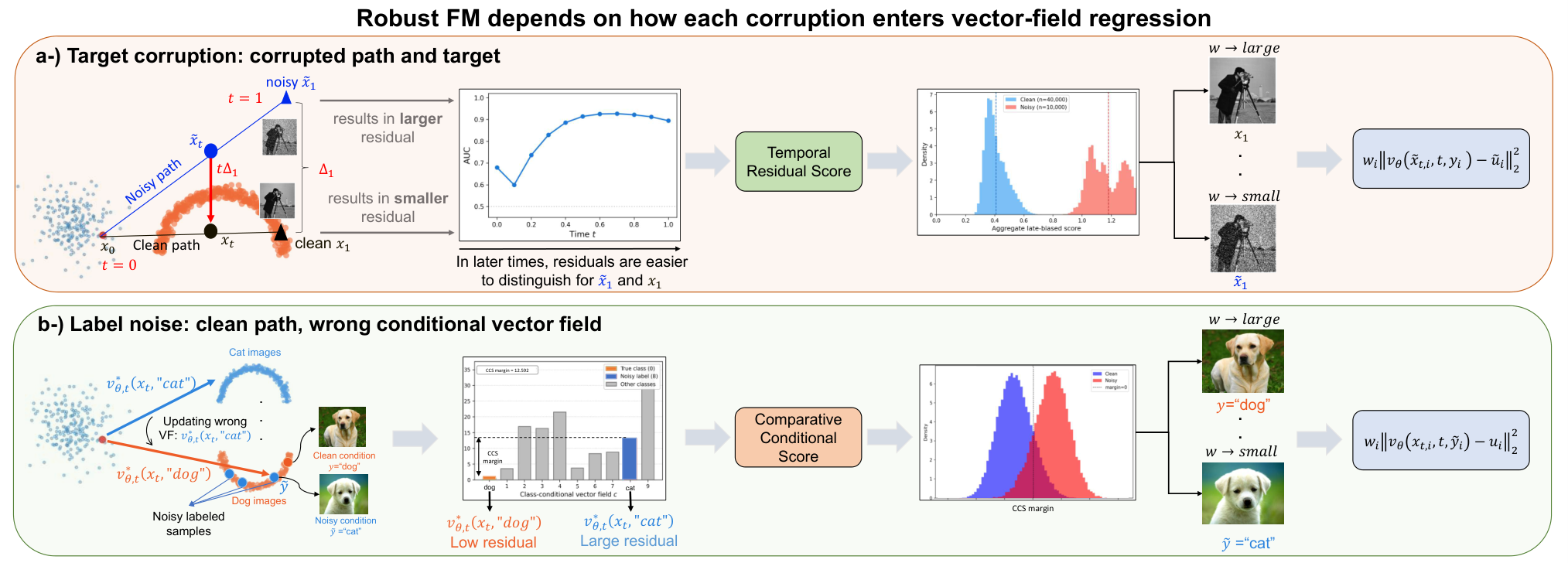
Across all experiments, the weighted FM models outperform standard FM and several robust‑training baselines (e.g., OT‑FM with L1 or Huber losses, DeepGUM, DivideMix). The improvements are most pronounced when corruption is severe, confirming that the residual structure carries reliable signal for detecting corrupted or mislabeled data.
How can Grafy users explore robust Flow Matching?
While Grafy does not yet host a dedicated Flow Matching studio, the research can be examined and prototyped using existing tools:
- Reader – Upload the PDF of the paper (or the arXiv URL) to the Grafy Reader (/reader) to ask the AI to summarize sections, extract equations, or compare the proposed scores with other robust‑training methods.
- Code – The authors released their implementation on GitHub. You can clone the repository and run the experiments inside Grafy Code (/code), which provides an AI‑assisted coding environment that can help you adapt the TRS/CCS weighting to your own FM models.
- Chat – If you are unsure how to integrate the weighting scheme into a custom FM pipeline, the Grafy Chat app (/chat) lets you query multiple models for step‑by‑step guidance, from data preprocessing to loss‑function modification.
By leveraging these apps, researchers and developers can quickly test the robustness ideas on their own datasets, even if they are using alternative generative frameworks such as diffusion or normalising flows.
Frequently asked questions
How does Temporal Residual Score decide which samples to down‑weight?
TRS computes the L2 norm of the FM residual at a randomly sampled time step that is biased toward later stages of the trajectory. Because target corruption inflates the residual more strongly as time progresses, samples with larger residuals—indicative of heavier corruption—receive lower soft weights in the loss function.
Why can’t standard robust loss functions (e.g., Huber) solve the label‑noise problem in Flow Matching?
Standard robust losses treat each data point independently and assume the corruption manifests as outliers in the regression target. In label noise, the regression target itself is correct, but it is evaluated under the wrong class‑conditional vector field, producing a systematic bias rather than an outlier. CCS explicitly compares the observed class residual with alternatives, a mechanism that generic robust losses lack.
Do TRS and CCS add significant computational overhead to training?
Both scores reuse the residuals already computed during FM training. TRS only requires sampling a later time step, while CCS evaluates the same trajectory under a few alternative class‑conditional fields (typically a small subset of classes). The authors report modest extra cost that scales linearly with the number of alternatives, which remains manageable even for CIFAR‑100 and WebVision.
Source: https://arxiv.org/abs/2611.13324
Source: Grafy Research Lab — Robust Flow Matching under Target Corruption and Label Noise
More news

One Trajectory, Two Requirements: Accuracy and Stability
A new study asks whether fixed robot AI step counts for accuracy can fail local stability. It says accuracy and Euler stability may need different budgets.

Frontier3DBench Tests Whether Coding Agents Build 3D Worlds
Einsia's Frontier3DBench tests whether coding agents can build 3D objects, scenes and working worlds; GPT-6.1-sol led overall. See what it means.

Anthropic launches Claude Fable 5.2, Mythos 5.2, cuts API prices 20%
Anthropic's Claude Fable 5.2 and Mythos 5.2 top several third-party benchmarks and cut API prices 20%. Here's what the effort settings mean for your bill.