Specialized residual streams improve multi-objective retrieval
Researchers found that assigning distinct learning objectives to parallel Transformer streams improves task performance and induces internal specialization.
 Source: Grafy Research Lab
Assigning different learning objectives to individual components of a Transformer's architecture can drive better performance in complex tasks. Researchers have demonstrated that by specializing parallel residual streams, models can more effectively handle complementary objectives like lexical and semantic retrieval.
What are Manifold-constrained Hyper-Connections?
Standard Transformer models typically rely on a single residual stream that carries information through the layers of the network. Manifold-constrained Hyper-Connections (mHC) represent an evolution of this architecture. According to the research by Shantanu Agarwal, Ruchita V. Maitri, Zhiqi Huang, Vivek Datla, and Alfy Samuel, mHC expands this single pathway into multiple parallel streams.
These streams are not isolated; they interact through learned connections at each layer's attention and feed-forward modules. The "manifold-constrained" aspect refers to a mathematical constraint applied to these connections, ensuring they remain doubly stochastic. This preservation of stability allows the model to benefit from learned interactions without losing the fundamental advantages of the residual pathway.
How does objective specialization work?
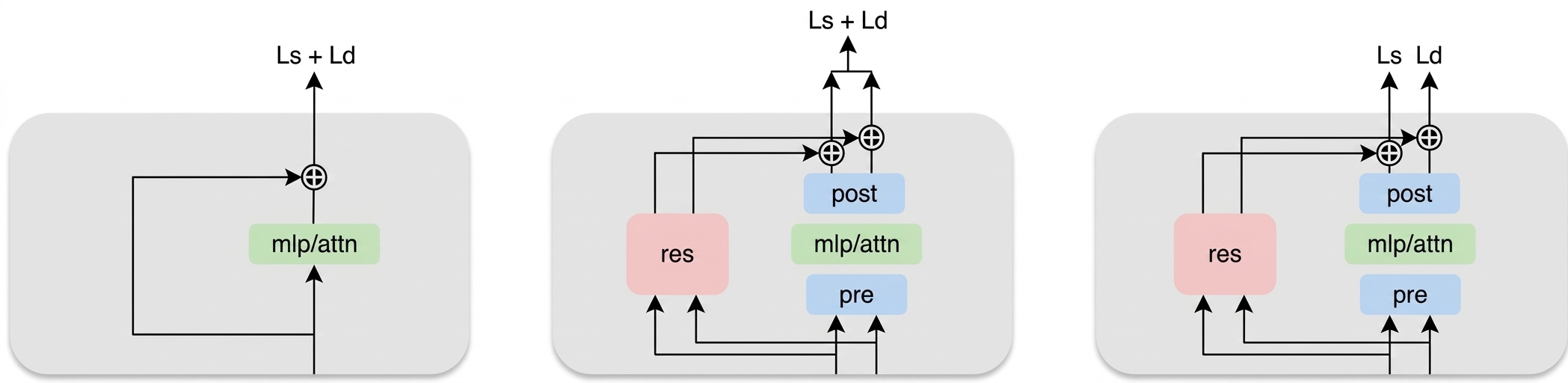
While previous work using mHC focused on training all parallel streams toward a single, shared objective, this new study investigates what happens when different streams are assigned different goals. The researchers used information retrieval as a test case, specifically looking at the relationship between lexical (sparse) matching and semantic (dense) matching.
In the proposed setup, different streams are assigned to a disjoint subset of objectives. Figure 1 shows the comparison between a standard single-stream encoder, a non-specialized mHC model where all streams share an objective, and the objective-specialized mHC model. By allowing streams to specialize, the model can leverage shared computation in the early layers while developing highly specific processing capabilities in the later layers.
Does specialization actually improve performance?
way, the results suggest that specialization provides a tangible boost in retrieval accuracy. The authors tested this using ModernBERT-base and ModernBERT-large scales across 13 BEIR benchmarks.
According to the study, the specialized mHC model consistently outperformed the non-specialized version across the entire range of sparse-to-dense fusion. For instance, at the base scale with two streams, the average nDCG@10 improved from 0.4310 to 0.4486. With four streams at the larger scale, the improvement was even more pronounced, moving from 0.4573 to 0.4748. This indicates that the architecture is not just capable of handling multiple tasks, but actually performs better when it is encouraged to differentiate its internal processing for each task.
How does the model change internally?
The researchers used various diagnostic tools to see how this specialization manifests within the neural network. They found that the specialized and non-specialized models behave quite similarly through the majority of the network. However, they diverge significantly in the final layers.
In these final layers, the specialized model shows several distinct characteristics:
- Gradient Flow: The gradients from different objectives become increasingly concentrated on the specific streams assigned to them.
- Routing Patterns: The read/write routing becomes asymmetric. The researchers observed that the MLP (Multi-Layer Perceptron) increasingly reads from the streams assigned to the sparse objective and writes toward the streams assigned to the dense objective.
- Representational Divergence: While streams in a non-specialized model remain highly similar throughout the network, the streams in a specialized model become increasingly dissimilar as they approach the output.
Interestingly, the authors found that fixing the residual mixing to the identity does not eliminate these benefits. This suggests that the performance gains are driven by the objective-specific read/write routing rather than the learned mixing between streams.
What are the implications for AI research?
This work suggests that the future of efficient, multi-task models may lie in structured, depth-dependent specialization. Instead of forcing a single representation to serve all purposes, architectures can be designed to allow for a period of shared computation followed by a divergence into task-specific expertise. This approach could lead to more robust retrieval systems and more capable multi-modal models that can balance competing requirements within a single unified framework.
If you are interested in exploring how modern AI models handle complex research papers and technical documentation, you can use Grafy Reader to search, question, and interact with academic PDFs using advanced AI models.
Frequently asked questions
What is the main difference between mHC and standard Transformers?
Standard Transformers use a single residual stream to propagate information through the network. Manifold-constrained Hyper-Connections (mHC) expand this into multiple parallel streams that can interact with each other through learned connections, providing more flexibility in how information flows through the model's depth.
Why does assigning different objectives to streams help?
Assigning distinct objectives allows specific streams to develop specialized representations for different tasks, such as lexical or semantic matching. This specialization prevents the different requirements of various tasks from interfering with each other, leading to improved performance in multi-objective scenarios like information retrieval.
Do the streams remain similar throughout the entire model?
No, the streams do not remain similar throughout the entire model. While the specialized and non-specialized models behave similarly through most of the network, they diverge in the final layers. In specialized models, streams assigned to different objectives become increasingly dissimilar as they approach the output layers.
Source: Shantanu Agarwal, Ruchita V. Maitri, Zhiqi Huang, Vivek Datla, Alfy Samuel (https://arxiv.org/abs/2611.24567)
More news

LSP-RAG improves knowledge graph retrieval for AI reasoning
Researchers have introduced LSP-RAG to enhance how AI models retrieve structured data, addressing accuracy and cost issues in complex reasoning tasks.

New DEO Method Fixes AI Retrieval Failures in Negation Queries
Researchers have introduced Direct Embedding Optimization (DEO) to solve how AI fails at exclusion queries. Learn how this training-free approach works.

Researchers find browser-embedded models can be used for attacks
Researchers demonstrate how attackers can leverage local models like Gemini Nano for post-exploitation, bypassing traditional network monitoring.