Task‑Aware Fusion Boosts Multimodal Materials Language Models
A new Task‑Conditioned Attention Fusion (TCAF) framework outperforms MatterChat on material property prediction.
 Source: Grafy Research Lab
A team of researchers from the University of Virginia, Lawrence Berkeley National Laboratory and Argonne National Laboratory introduced Task‑Conditioned Attention Fusion (TCAF), a lightweight bridge that dynamically combines multiple structural encoders for multimodal materials language models. The work matters because it delivers substantially better property predictions while using far fewer parameters and half the training time compared with the prior state‑of‑the‑art MatterChat system.
What is Task‑Conditioned Representation Fusion (TCAF)?
TCAF is an attention‑based bridge that sits between frozen 3D material encoders and a frozen large language model (LLM). It receives atom‑level embeddings from two encoders – the supervised CHGNet and the generative Zatom‑1 – and compresses them into a small set of latent tokens using a Perceiver‑style cross‑attention block. Crucially, the bridge incorporates task‑conditioned latent queries: a learned residual vector is added to each of the 32 latent queries based on the property requested in the natural‑language prompt. These queries steer the cross‑attention to attend to different encoder sources and to different depths of Zatom‑1, allowing the model to extract the most relevant structural information for each specific prediction task. Figure 1 shows the overall architecture, including the frozen encoders, the Perceiver bridge, and the LLM that generates the final answer.
How does TCAF differ from MatterChat?
MatterChat connects a single structural encoder (CHGNet) to an LLM via a large BLIP‑2‑style bridge and relies on a two‑stage training pipeline: first a contrastive alignment of structural and textual modalities, then supervised fine‑tuning on downstream tasks. TCAF replaces that heavy bridge with a much smaller Perceiver module and eliminates the separate contrastive stage. The bridge is trained in a single stage directly on the downstream language‑modeling objective, which means representation selection, fusion, and material‑language alignment are learned jointly. As a result, TCAF uses at least 80% fewer trainable parameters and reduces overall training time by 50% while still delivering higher accuracy.
What performance gains does TCAF deliver?
Across a suite of classification and regression benchmarks, TCAF consistently outperformed MatterChat. On regression tasks the root‑mean‑square error (RMSE) dropped by up to 47.8% compared with the baseline. For classification, the three‑encoder configuration (CHGNet, Zatom‑1, and UMA‑S) achieved a macro‑average accuracy of 89.61%, the highest reported in the study. Even when using only the two primary encoders, TCAF recorded lower RMSE on all three regression targets and higher accuracy on every classification task listed in the paper. These gains were achieved while training a model with far fewer parameters, demonstrating that task‑aware attention can replace the heavyweight alignment mechanisms previously considered necessary.
Which structural encoders are combined and why?
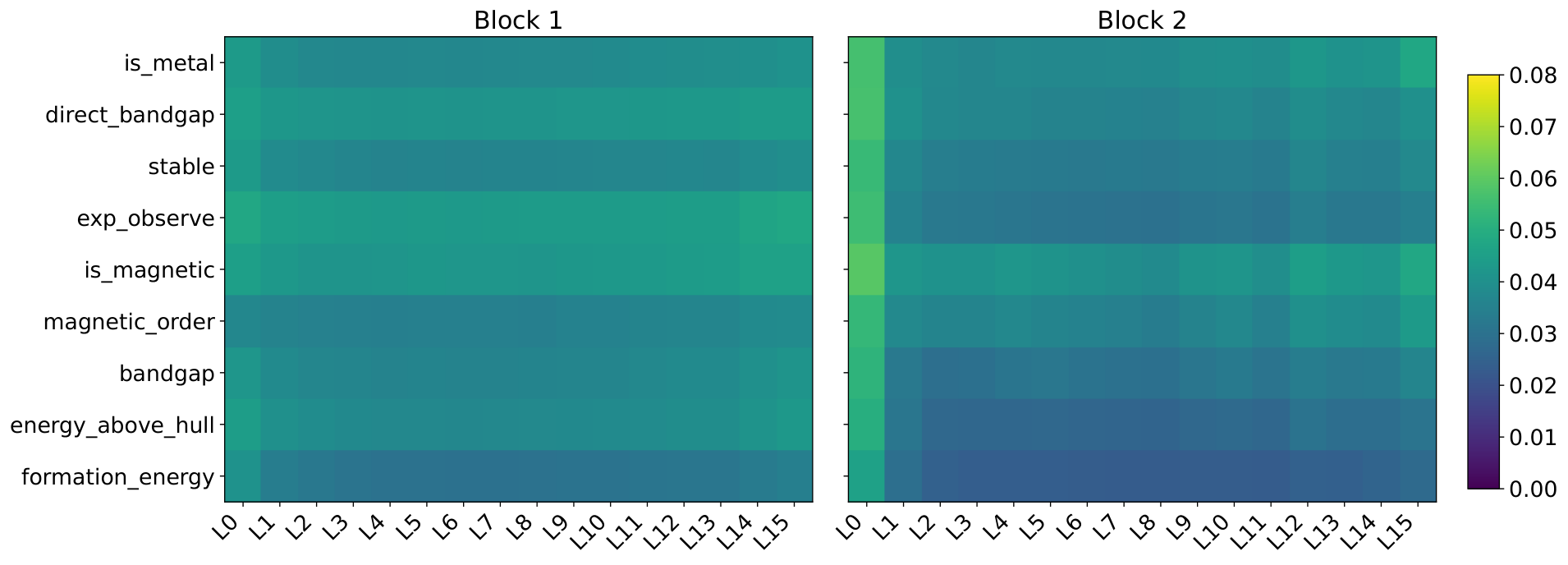
The authors selected CHGNet, a supervised machine‑learning interatomic potential, and Zatom‑1, a generative flow‑matching model for 3D molecules and materials. Analysis showed that CHGNet provides strong supervised features, while Zatom‑1 offers complementary information that is distributed across its intermediate layers rather than being concentrated in the final representation. Linear probing experiments (Table 1 in the paper) revealed that the most informative Zatom‑1 layer varies by property – for example, layer L0 is best for predicting metallicity, whereas layer L2 excels for direct band‑gap estimation. By exposing all 16 Zatom‑1 layers to the bridge, TCAF can dynamically route attention to the depth that best supports the queried property, a capability visualized in Figure 8, which contrasts the attention distribution of a non‑conditioned baseline with the task‑aware pattern of TCAF.
How can creators and researchers explore TCAF with Grafy?
Grafy’s Reader app lets users upload the arXiv PDF and interactively query the paper, reproducing the authors’ experiments or extracting specific details without leaving the workspace. For developers who want to prototype the TCAF pipeline, the Code studio provides an AI‑assisted coding environment where the Perceiver bridge and cross‑attention logic can be assembled using Python libraries such as PyTorch. Researchers interested in visualising the flow of attention across encoder layers can use the Graph app to build a branching prompt‑output diagram that captures how different task‑conditioned queries lead to distinct attention patterns – an effective way to illustrate the findings from Figure 8. Finally, the Chat interface can be used to ask the LLM about best practices for integrating additional encoders (e.g., UMA‑S) into a TCAF‑style system, leveraging the same multimodal reasoning that the paper demonstrates.
Source: Huu Binh Ta et al., "Choosing the Right Representations: Task‑Aware Fusion for Multimodal Materials Language Models," arXiv:2611.24641, 19 Nov 2026.
Frequently asked questions
How does TCAF select which Zatom‑1 layer to use for a given property?
TCAF uses task‑conditioned latent queries that are added to the bridge’s 32 latent tokens. During cross‑attention, these queries bias the attention weights toward the encoder layers that contain the most predictive signals for the requested property, as shown by the heatmaps in Figure 8.
Does TCAF require a separate contrastive pre‑training stage?
No. Unlike MatterChat, TCAF is trained end‑to‑end on the downstream language‑modeling objective, removing the need for a dedicated contrastive alignment phase and cutting training time in half.
Can TCAF be extended to more than two structural encoders?
Yes. The authors demonstrated flexibility by adding UMA‑S as a third encoder, achieving the highest macro‑average classification accuracy (89.61%). The Perceiver bridge can ingest additional frozen encoder streams without changing its core architecture.
More news

New DEO Method Fixes AI Retrieval Failures in Negation Queries
Researchers have introduced Direct Embedding Optimization (DEO) to solve how AI fails at exclusion queries. Learn how this training-free approach works.

Researchers find browser-embedded models can be used for attacks
Researchers demonstrate how attackers can leverage local models like Gemini Nano for post-exploitation, bypassing traditional network monitoring.

New PRKV method uses PageRank to optimize LLM memory
Researchers have introduced PRKV, a training-free method to reduce KV cache memory via PageRank. Learn how it maintains performance at 90% compression.