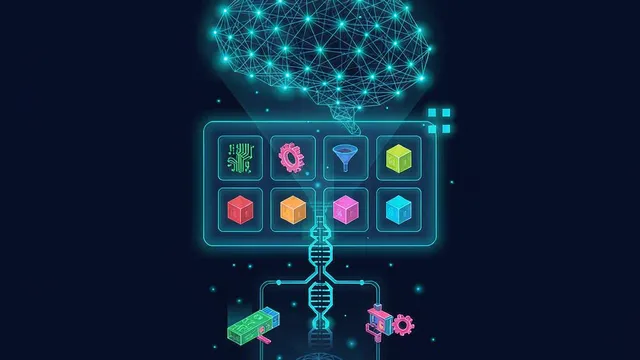
ToolSmith framework automates tool generation for AI agents
Researchers have introduced ToolSmith, a framework that allows multimodal search agents to automatically create new tools to solve complex queries.
The AI news that matters for people who make things — what happened, and how to put it to work in Grafy.

Researchers have introduced ToolSmith, a framework that allows multimodal search agents to automatically create new tools to solve complex queries.

Researchers propose the Open Process Control Plane to manage AI agent actions. Learn how this separates agent proposals from business authority.

Researchers have identified a new failure mode where an AI agent's own correct decisions lead it to violate safety policies later in a session.

Google DeepMind used teams of Gemini 4 agents and Lean theorem proving to significantly reduce the computational cost of complex quantum algorithms.

Anthropic has released Claude Ship to automate GitHub pull request reviews and fixes. Learn how these new agents impact the developer workflow.

Researchers have introduced WEIR to improve multi-turn agent training by addressing flaws in prefix-tree methods and reward estimation. Learn more.

Hugging Face outlines the transition from question-answer benchmarks to complex agentic evaluations and provides a framework for building them.

Researchers have introduced ProbeAgent, a framework that automatically discovers and categorizes why AI agents fail in complex, multi-step environments.

A coordinated swarm of AI agents is working live to solve the P vs NP problem. Learn how this automated mathematical research effort operates.

Google has launched a preview of Gemini API Tool Retrieval, allowing AI agents to manage massive tool libraries efficiently by loading schemas on demand.

Pandex has released a specialized API and MCP server providing access to 2.8 million official European legal documents for AI-driven compliance.

Apple is seeking engineers to build AI agents capable of web browsing and app interaction. Discover what this means for the future of agentic AI.

Researchers introduced BuggyMLE to test AI agents on complex, multi-file machine learning repositories by injecting controlled bugs into real codebases.

Researchers have proposed ARISE, a memory architecture that allows enterprise AI agents to learn from failures without retraining their underlying models.

Researchers have introduced EpiCompass, a scaffold that helps AI agents manage hypotheses and evidence to reduce errors in automated scientific research.

Researchers have introduced GUARD, a framework designed to prevent AI agents from losing previously learned skills while they autonomously update their own.

Researchers have introduced MemFolder, a framework that reduces both the number of memory records and their length to improve AI agent efficiency.

Researchers have introduced a theory of software thermodynamics to analyze the token efficiency of coding agents, distinguishing work from wasted heat.

Researchers have introduced AnyS1, a framework that uses a lightweight model to handle routine agent decisions, cutting costs by up to 91%.

Learn how to identify seven critical failure modes in AI agents, from contract mismatches to indirect injection, to ensure reliable production deployment.

Researchers have introduced AutoRAGBench to evaluate how well AI agents can autonomously design and refine RAG pipelines in open coding environments.

Researchers propose NariQ, a new quantization method that optimizes models for long-horizon tasks, preventing performance drops in agentic workflows.

Researchers have introduced SheetAlign, a new framework designed to help AI agents navigate and manipulate complex spreadsheets through stage-isolated learning.

Developers are implementing five specific guardrails to prevent AI agents from causing unintended harm, ensuring safer autonomous operations.

Researchers have introduced Seer, a framework that uses shared decision models to help small, local AI agents perform complex deep-research tasks.