Active Learning Model Cuts LLM Retrieval Energy by 96% for Long Queries
Researchers introduced the LLM Active Approximation Model (LAAM), a hybrid retrieval system that preserves most of the relevance of full LLM reranking.
 Source: Grafy Research Lab
Search engines and large language models (LLMs) have complementary strengths for document retrieval, but combining them has traditionally been too costly in energy and latency. A new study from the Grafy Research Lab proposes a hybrid framework— the LLM Active Approximation Model (LAAM)—that preserves most of the semantic gains of LLM reranking while consuming only a fraction of the power required for full LLM inference.
What problem does LAAM aim to solve?
Lexical retrievers such as BM25 are extremely fast and energy‑efficient, but they struggle with long, context‑rich queries that need semantic understanding. LLMs excel at interpreting those verbose queries, yet a single LLM evaluation can consume an order of magnitude more energy than a traditional search. According to the paper, a Google web search emits about 0.2 g CO₂ (≈0.3 Wh) while a ChatGPT request can use around 2.9 Wh, roughly ten times more. When hundreds of documents are reranked per query, the energy cost multiplies dramatically, creating a barrier for sustainable large‑scale retrieval.
How does LAAM work?
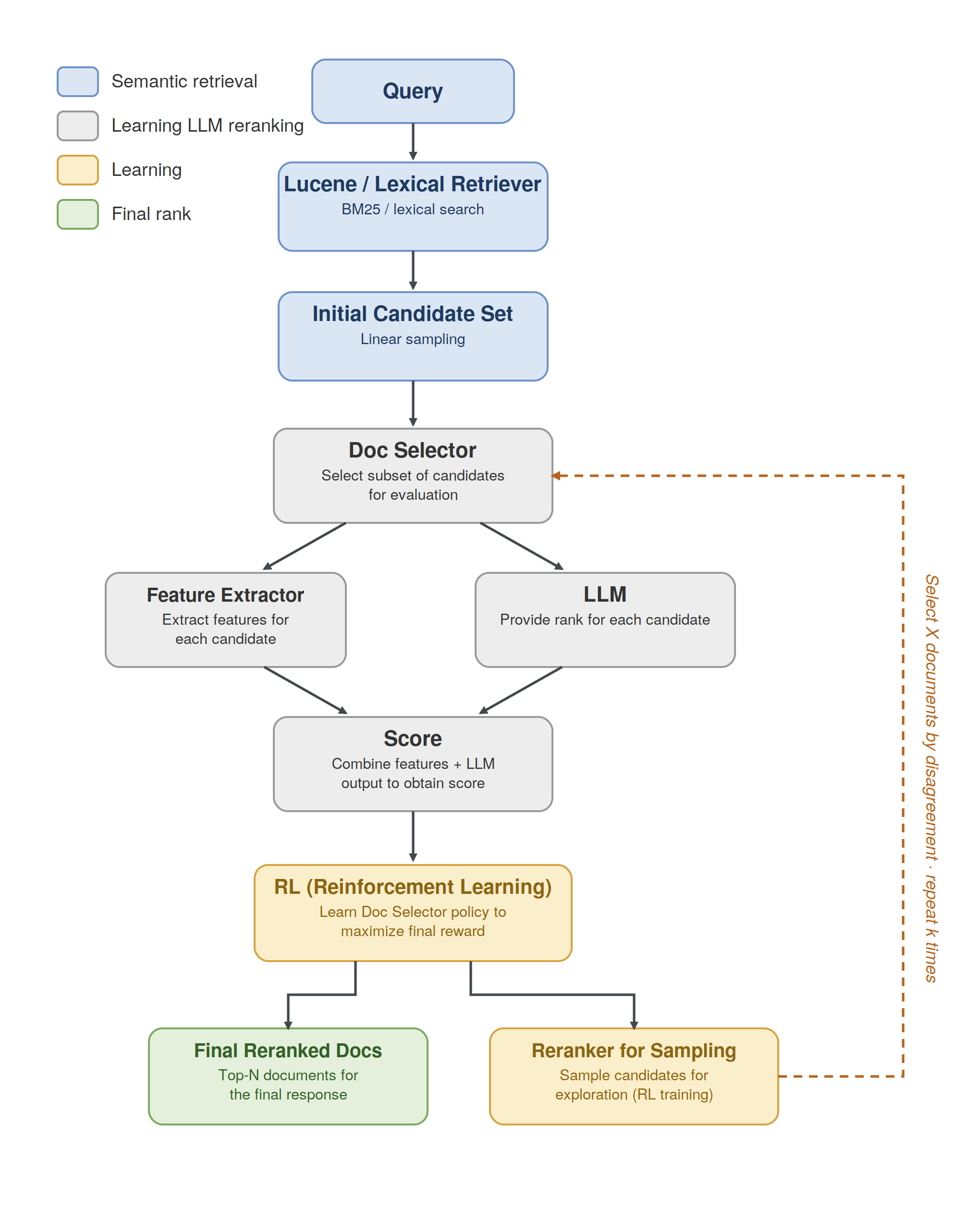
LAAM inserts a lightweight learned predictor between the initial lexical retrieval step and the expensive LLM reranking. The process consists of three stages:
- Lexical Search – A standard BM25 query returns a ranked list of candidate documents.
- Predictor Approximation – The predictor, trained on a small seed set of LLM‑labeled documents, estimates the relevance scores that the LLM would assign, using features derived from the query, document metadata, and embedding vectors.
- Active Learning Loop – At each iteration, the system selects the most informative unlabelled document, asks the LLM to score it, and updates the predictor. This greedy selection concentrates LLM calls on documents that are expected to reduce uncertainty the most.
Figure 1 shows the architecture, highlighting the flow from lexical retrieval through the LAAM predictor to the final ranking. By controlling how many documents are sent to the LLM (the "budget"), practitioners can directly trade off accuracy against energy consumption.
How well does LAAM perform?
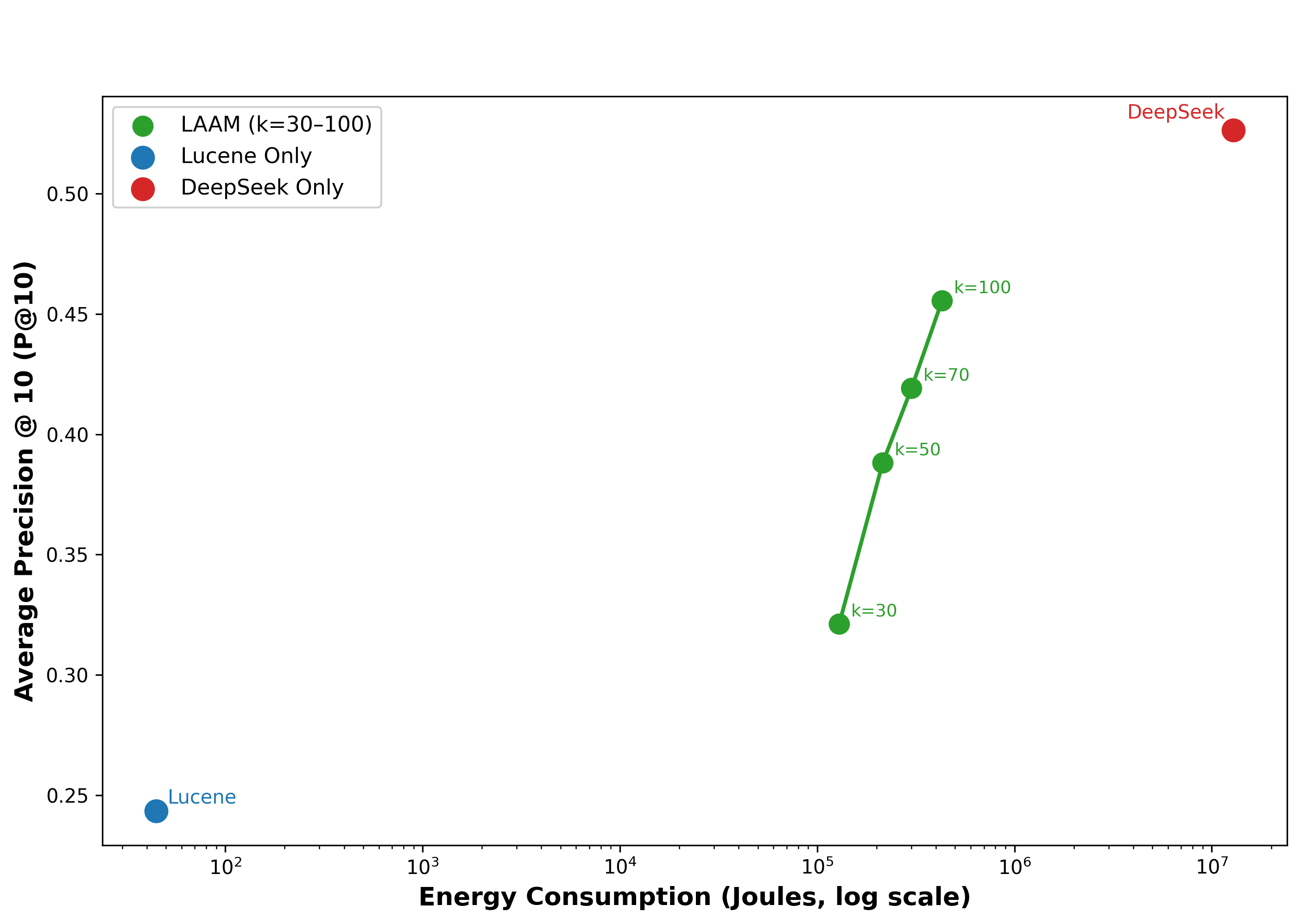
The authors evaluated LAAM on the TREC Robust 2004 benchmark using Lucene BM25 and DeepSeek v3 as the LLM, testing three query formulations: title (short), description (medium), and narrative (verbose). For the most demanding verbose queries, LAAM achieved 0.459 average P@10, which is 87 % of the 0.526 P@10 obtained by reranking the full candidate set with DeepSeek. Crucially, this performance required only 3.3 % of the per‑query energy consumption. Figure 2 plots the energy–accuracy trade‑off, illustrating a steep performance gain with the first few LLM evaluations and diminishing returns thereafter. The study also reports that LAAM is statistically significantly better than BM25 alone and statistically indistinguishable from full LLM reranking on @1 and @10 precision, though MAP differences remain.
Why does energy matter for retrieval systems?
Beyond carbon footprints, energy usage translates to operational costs, especially for large‑scale search services handling billions of queries daily. By treating energy as a first‑class retrieval metric, LAAM offers a practical lever for engineers to meet sustainability targets without sacrificing user experience for complex queries. The framework also aligns with emerging "green IR" research agendas that call for cost‑aware algorithm design.
How can developers try LAAM with Grafy?
Grafy does not yet ship a dedicated LAAM component, but the workflow can be assembled using existing apps:
- Reader – Upload the TREC Robust 2004 collection (or any document set) as PDFs or plain text. The Reader can extract text and metadata for feature generation.
- Chat – Use a lightweight model (e.g., a fast open‑source LLM) to generate the initial relevance scores for a small seed set. The same Chat interface can invoke the larger DeepSeek‑style model for the active‑learning queries.
- Graph – Build a branching graph that records each iteration: the lexical BM25 list, the predictor’s estimated scores, the LLM‑labeled documents, and the updated model parameters. This visual trace mirrors the incremental refinement described in the paper.
- Code – Implement the predictor (a simple regression or gradient‑boosted tree) and the greedy selection logic in Grafy Code. Because Grafy supports multiple cloud model providers side‑by‑side, you can experiment with different embedding models and observe their impact on the energy–accuracy curve.
By stitching these apps together, developers can reproduce the LAAM experiment on their own corpora, measure energy usage via Grafy’s built‑in monitoring tools, and fine‑tune the labeling budget to meet specific latency or carbon constraints.
What are the limitations and next steps?
While LAAM shows strong results on a classic benchmark, its performance depends on the quality of the initial seed set and the choice of features. The study notes that for short queries the gains shrink, suggesting that the predictor’s advantage is most pronounced when semantic nuance matters. Future work could explore richer document representations, multi‑stage active learning (labeling batches instead of single documents), or integrating query‑expansion techniques to further boost recall.
Source: Grafy Research Lab, https://arxiv.org/abs/2611.16488
Frequently asked questions
How much energy does LAAM save compared to full LLM reranking?
On verbose narrative queries, LAAM consumes about 3.3 % of the per‑query energy that a full DeepSeek reranking would require, while still achieving 87 % of the average P@10 score.
Can LAAM be used with any LLM or only DeepSeek?
The framework is model‑agnostic. The paper demonstrates it with DeepSeek v3, but the predictor only needs relevance judgments from the chosen LLM, so any capable model can be swapped in.
What Grafy app should I start with to experiment with LAAM?
Begin with the Reader app to ingest your document collection, then use Chat for lightweight inference and Code to implement the active‑learning loop. The Graph app helps visualise each iteration.
More news

Cmpnd launches dspy-wsp: weight‑space programming
Cmpnd released dspy-wsp, a prototype DSPy optimizer that edits model weights directly without gradients.

Stanford Open-Sources Memorilla, a 16‑Token Memory Module for Frozen LLMs
Stanford researchers released Memorilla, an open‑source module that compresses a document collection into just 16 memory tokens for frozen Qwen3‑8B.

Prefix‑Guided Sampling Cuts Test‑Time Costs While Boosting LLM Reasoning
A new method called Prefix‑Guided Sampling (PreG) uses early confidence signals to prune low‑quality reasoning paths.