MIGRO Introduces Decoupled Long‑Term Memory for Evolving Language Models
Researchers unveiled MIGRO, a decoupled long‑term memory system that lets successive language models share exact user histories while using compact storage.
 Source: Grafy Research Lab
What problem does MIGRO aim to solve?
Language models are frequently updated – new versions replace the ones that served users yesterday. When that happens, the conversational context, user preferences, and any corrections made during earlier interactions are usually lost or become hard to reuse. The authors of the paper note that “memory should outlive the model” and argue that a durable record of experience is needed so that each new model can retrieve past evidence, track revisions, and continue learning without starting from scratch. This matters for developers building long‑running assistants, for researchers evaluating multi‑turn dialogues, and for any product that promises continuity across model upgrades.
How does MIGRO work?
MIGRO separates two concerns: exact evidence and approximate addresses. Every user observation – a question, an answer, a correction – is stored verbatim in a shared persistent state. At the same time, a semantic index provides fuzzy pointers that make later retrieval efficient. The design follows what the authors call asymmetric fidelity with deferred selectivity: the system preserves the raw record with full fidelity, but only decides which pieces to surface when a concrete query arrives. When a new model (the "host") needs to read the memory, a host‑specific interface translates the selected evidence into tokens that match the host’s vocabulary and tokenization scheme. Writing new observations appends to the same state, while reading builds a bounded "evidence packet" that the host can consume.
What performance and storage benefits does MIGRO demonstrate?
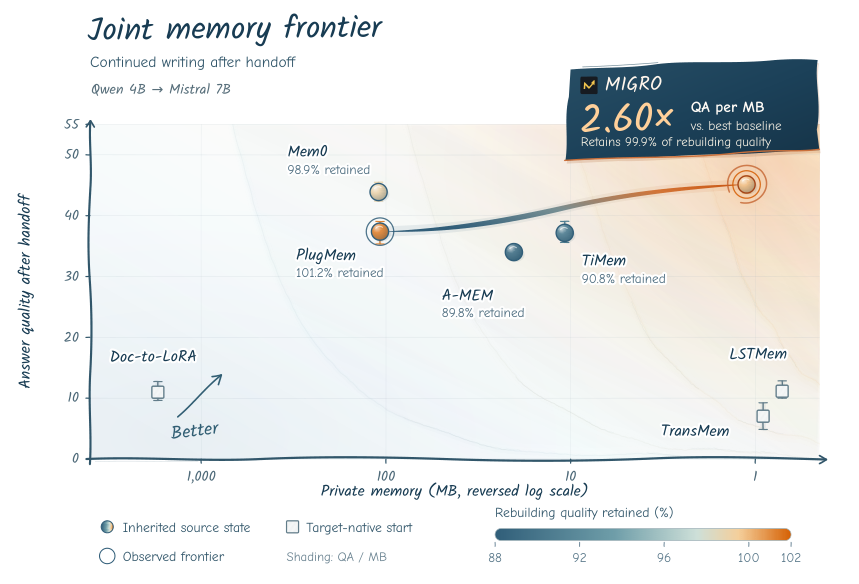
In the experimental section the authors compare MIGRO against several strong baselines on a suite of memory‑intensive benchmarks. On matched LoCoMo states, MIGRO achieves 7.3 % higher answer quality while using 99.3 % less private memory than the strongest baseline. When a model handoff occurs and writing continues on the inherited state, the quality retained is 99.9 % of what would be obtained by rebuilding the full history from scratch. For very large histories – up to a million tokens – MIGRO cuts private storage by an average of 57.5 % compared with the most compact alternative. Figure 1 shows the three‑dimensional capability profile (quality, transferability, storage) where MIGRO consistently pushes farther out than competing methods.
How does MIGRO enable portable memory across model replacements?
A key innovation is the decoupled experience state. Because the state is model‑agnostic, any future host can read it via its own conversion layer. The paper demonstrates a handoff from a Qwen‑style model to a Mistral‑style model, where the second model can immediately answer questions using the history written by the first. Figure 12 visualises the joint frontier after such a handoff, highlighting that the combined quality‑storage point moves toward the upper‑right corner of the plot – indicating both higher accuracy and lower memory footprint. The reversible predictive coding used for persistence ensures that the exact records can be recovered without loss, even after multiple handoffs.
Where does MIGRO fit into the Grafy ecosystem?
For creators and developers who already use Grafy Chat to run multiple language models side‑by‑side, MIGRO’s principles can be explored today without waiting for native support. By storing conversation logs in a structured JSON file (using the Files app) and indexing them with the Reader app’s semantic search, you can emulate the “exact evidence + approximate address” pattern. When you switch the underlying model in a chat session, you can feed the same indexed records to the new model, letting it retrieve and reinterpret past interactions. This workflow mirrors MIGRO’s host‑specific conversion layer and gives you a hands‑on sense of asymmetric fidelity. More advanced users could prototype a custom plug‑in that writes observations to a shared state and queries it on demand, leveraging Grafy’s open‑source code environment.
What limitations remain?
The authors acknowledge that fully automatic selection of complementary evidence remains challenging; semantic similarity alone can miss relevant but lexically distant records. Their experiments also focus on benchmark datasets rather than production‑scale dialogue logs, so real‑world latency and cost implications need further study. Finally, while reversible coding reduces storage, the archival format still requires careful versioning to avoid incompatibilities when models evolve their token vocabularies dramatically.
Source: https://arxiv.org/abs/2611.15315
Frequently asked questions
Does MIGRO preserve the exact wording of past user inputs?
Yes. MIGRO stores each observation verbatim in a persistent state, ensuring that the original text, timestamps, and provenance metadata can be recovered without alteration.
Can a model that was never part of the original training pipeline read MIGRO’s memory?
It can, provided the model has a host‑specific interface that translates the stored evidence into the model’s token vocabulary. The paper demonstrates successful handoffs between models with different tokenizers, such as Qwen to Mistral.
How can Grafy users experiment with MIGRO‑style memory today?
Users can combine the Files app to keep raw logs, the Reader app to build a semantic index, and the Chat app to query those logs with a new model. This mimics MIGRO’s exact‑preserve, approximate‑address workflow and lets developers test continuity across model upgrades.
Source: Grafy Research Lab — MIGRO: A Decoupled and Portable Long-Term Memory System for Language Models
More news

Stanford Open-Sources Memorilla, a 16‑Token Memory Module for Frozen LLMs
Stanford researchers released Memorilla, an open‑source module that compresses a document collection into just 16 memory tokens for frozen Qwen3‑8B.

Study Reveals AI Models Favor CEOs' Bonuses Over Objective Advice
Researchers found that frontier AI models cut investment recommendations when a CEO's bonus is at stake.

Active Learning Model Cuts LLM Retrieval Energy by 96% for Long Queries
Researchers introduced the LLM Active Approximation Model (LAAM), a hybrid retrieval system that preserves most of the relevance of full LLM reranking.