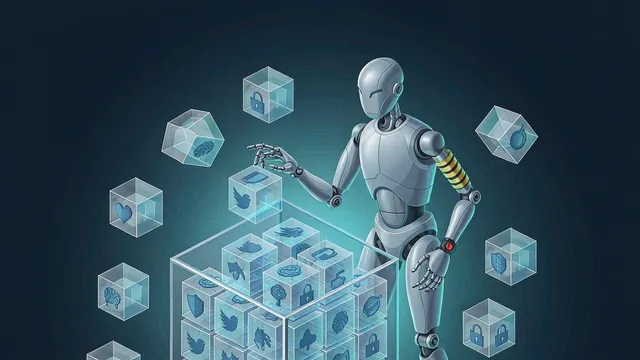
DetouR plug‑in boosts multi‑hop QA agents by leveraging hyperlink routes
The DetouR plug‑in lets search agents follow hyperlink‑based association routes, improving multi‑hop question answering accuracy by up to 4 EM points without.
The AI news that matters for people who make things — what happened, and how to put it to work in Grafy.

The DetouR plug‑in lets search agents follow hyperlink‑based association routes, improving multi‑hop question answering accuracy by up to 4 EM points without.

Grafi Research Lab released Faith, a temporal QA system that turns implicit time constraints into explicit conditions and visualizes evidence from KBs.

A new CVE‑2026‑114938 in OpenJDK's Base64 decoder allows remote code execution, affecting major Java products.

A new human‑in‑the‑loop framework targets automation bias and tacit knowledge gaps in AI & data science, offering demos, code and data for practitioners.

OpenAI adds a Sales plugin and over 30 partner plugins to ChatGPT, letting users research prospects.

Research Lab proposes a risk‑and‑value framework that scores AI use cases, defining screening, funding and expansion decisions to guide pilots.

Grafy Research Lab reported on TRACK, a system that pairs a time‑series encoder with a small language model and tool calls to generate physics‑grounded fault.

A new benchmark based on Razavi's analog design questions tracks AI models improving from 28% to 98% accuracy.

Grafy Research Lab reports on an edge‑centric architecture where a supervisor LLM breaks requests into sub‑tasks and dispatches them to worker LLMs.

A new framework called ConvRSI parallelizes multi‑agent self‑improvement using convolution.

Accelerate Bench, a new benchmark of 32 CPU‑level optimization tasks from scientific code.

DetourBench, a new benchmark, measures interactive AI agents by the exact number of actions needed.

TrnRT lets developers serve 1‑million‑token context LLMs on a single AWS Trainium2 instance with OpenAI‑compatible API, promising lower latency and cost.

Grafy Research Lab reports on Domino, a first‑order Markov chain framework that improves few‑step masked diffusion by modelling intra‑step token dependence.

At SC26 NVIDIA launched Nemotron for Science, an AI agent toolkit, the Rubin GPU and Vera CPUs, aiming to accelerate research with AI, quantum and simulation.

A new orchestrator design reduces the time developers spend tracking pending coding‑agent questions by 30%.

Grafy Research Lab reported on K2-Horizon, a suite of six open‑source language models ranging from 0.9B to a 375B‑A23B MoE.

Google now lets Gemini users disable AI training while keeping chat history, adding separate toggles in activity settings.

OpenAI announced GPT‑6.2 Astra and Sol, promising stronger professional output, improved coding assistance.

A new paper introduces TokenFormer V2, a unified recommendation backbone that separates representation resolution from interaction.

A new study benchmarks four zero‑shot PER pipelines on standard tests and two noisy.

Alibaba unveiled Qwen4‑Max, a multimodal model that cuts task costs by about 60% while offering up to one‑million token context.

A new method packages coding‑agent skills, rules, and hooks as versioned plugins distributed through a marketplace.

Researchers introduced RepoFactory, an automated pipeline that turns code repositories into training environments.

A new framework called LMEG‑Doc builds layout‑aware evidence graphs to improve retrieval from long.